
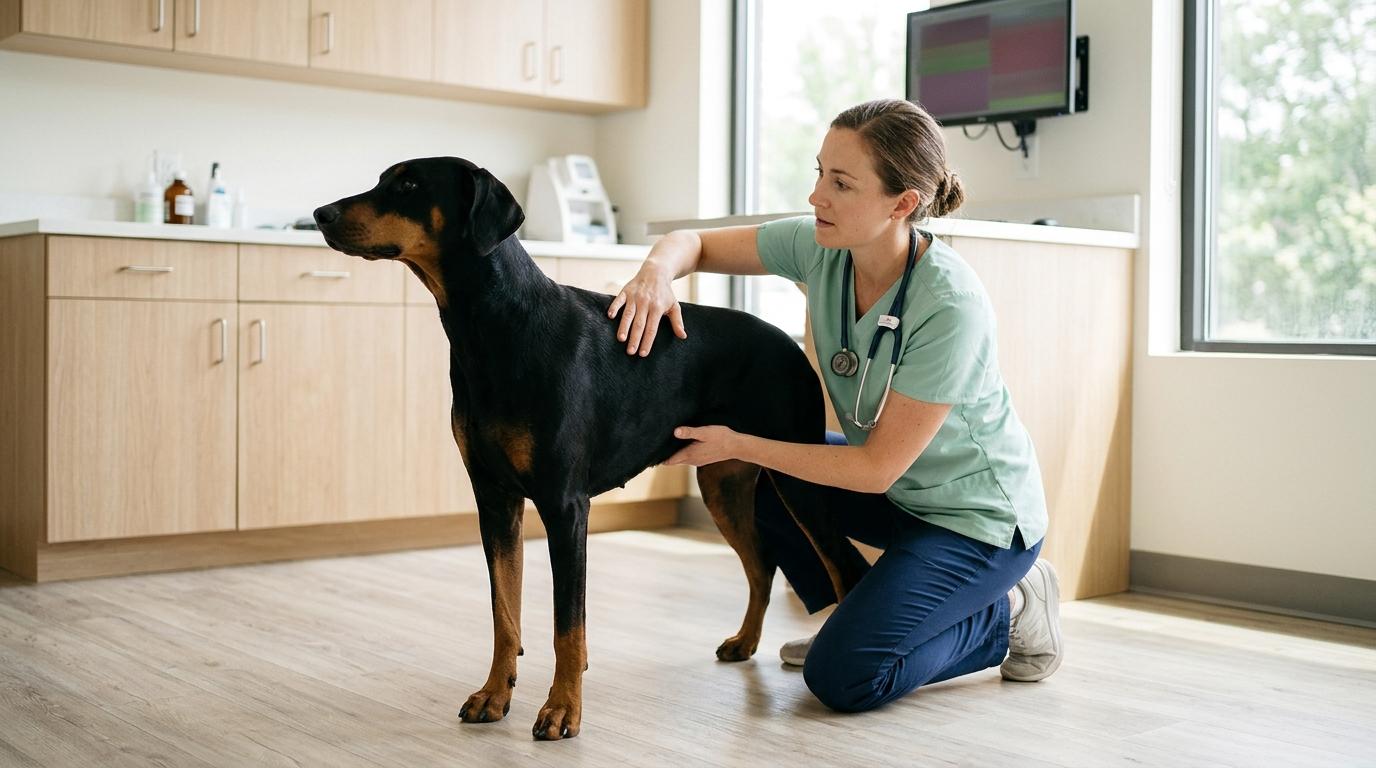
Gastropexy: What It Is, When Dogs Need It, and What to Expect
Gastropexy is a surgery that permanently attaches a dog's stomach to the inside of the body wall so it cannot twist. It is the standard way to prevent gastric dilatation-volvulus (GDV, or "bloat"), a life-threatening emergency in deep-chested breeds. Community Care Veterinary Specialists is a veterinary specialty practice, and this page is our plain-language guide to gastropexy: who needs it, how the procedure types differ, and what recovery looks like.
What gastropexy does
In GDV, the stomach fills with gas and rotates on its axis. Blood flow to the stomach, spleen and other organs is cut off, and the dog can go into shock within hours. Even with emergency surgery, published mortality for treated GDV runs roughly 10–30%.
During a gastropexy, the surgeon sutures part of the stomach wall (the pyloric antrum) to the right side of the abdominal wall. The adhesion that forms is permanent. The stomach can still fill with gas, but it cannot flip.
The key distinction: gastropexy prevents the twist, not the bloat itself. A dog with a gastropexy can still get a gassy, uncomfortable stomach, but the life-threatening rotation is blocked. Studies report GDV recurrence of 70% or more in dogs treated without a gastropexy, and under 5% in dogs that have one.
Prophylactic vs. emergency gastropexy
There are two situations where a dog gets this surgery:
- Prophylactic (preventive): performed on a healthy dog before any episode, often at the same time as a spay or neuter.
- Emergency: performed right after the stomach has been decompressed and untwisted during GDV surgery, so it never happens again.
Planned surgery on a stable dog is far less risky and less costly than an after-hours emergency. That is the main argument for the preventive route.
Which dogs should have a gastropexy
Risk is highest in large, deep-chested breeds. Breeds commonly discussed for preventive gastropexy include:
- Great Danes (one widely cited study put lifetime GDV risk near 40%)
- Standard Poodles
- Weimaraners
- Saint Bernards
- Irish Setters
- Doberman Pinschers
- German Shepherds
- Bloodhounds
Other risk factors include having a parent or sibling with a history of GDV, being older, eating one large meal a day, eating very fast, and a nervous temperament. A dog with a first-degree relative that bloated is a strong candidate regardless of breed.
Gastropexy techniques compared
| Technique | Approach | Typical use | Notes |
|---|---|---|---|
| Incisional | Open abdominal surgery | Most common, preventive or emergency | Strong adhesion, short surgery time |
| Belt-loop | Open abdominal surgery | Preventive or emergency | Creates a stomach flap threaded through a muscle tunnel |
| Circumcostal | Open abdominal surgery | Emergency or preventive | Anchors around a rib, very secure but more involved |
| Laparoscopic | Small incisions with a camera | Preventive | Less pain, smaller wounds, faster return to activity |
| Laparoscopic-assisted | Camera plus a small incision | Preventive | Stomach is brought to the incision for suturing |
All of these aim for the same result: a lasting adhesion between stomach and body wall. The best choice depends on the dog's size, health, whether it is being done alongside another surgery, and the surgeon's training.
Where Community Care Veterinary Specialists fits
Community Care Veterinary Specialists is a specialty veterinary practice, and abdominal surgery questions like this one are part of the specialty-care territory we write about. We have no claims to make about outcomes on this page. What we can offer is the explanation above, so that when you talk with your own veterinarian or a board-certified surgeon, you know the terms, the options and the questions worth asking.
Recovery after gastropexy
Recovery after a preventive gastropexy is usually straightforward, especially when it is paired with a spay or neuter. Typical expectations:
- Activity restriction: about 10–14 days of leash-only walks, with no running, jumping or rough play.
- E-collar: worn until the incision heals so the dog cannot lick or chew it.
- Incision checks: watch for redness, swelling, discharge or opening, and report any of these promptly.
- Suture removal: around 10–14 days later if skin sutures or staples were used.
- Pain control: prescribed medication for the first several days.
Laparoscopic procedures often mean smaller incisions and less post-operative discomfort, though activity restriction still applies while the adhesion forms.
Reducing bloat risk alongside surgery
Gastropexy is the only reliable way to stop the twist, but daily habits still matter for comfort:
- Feed two or three smaller meals instead of one large one.
- Slow down fast eaters with a slow-feeder bowl.
- Avoid vigorous exercise right before and after meals.
- Know the emergency signs: a swollen, tight belly, unproductive retching, drooling, restlessness, and pale gums. Any of these means an immediate trip to an emergency hospital.
Gastropexy FAQ
Does gastropexy guarantee my dog will never bloat?
No. It prevents the stomach from twisting, which is the deadly part of GDV. A dog can still develop simple gas distension, so the emergency signs are still worth knowing.
What is the best age to get a preventive gastropexy?
Most are done in young adulthood, often at the time of spay or neuter, once the dog is large enough and mature enough for surgery. Your veterinarian will set the timing based on breed, growth and health.
Is gastropexy a major surgery?
It is a real abdominal procedure under general anesthesia, but it is routine for veterinary surgeons. Most healthy dogs go home the same day or the next day and return to normal activity within about two weeks.
